I'm writing an article on prose depictions of duelling in the 1710s and '20s and I've had occasion to revisit the duel between Sir Chomley Deering and Col. Richard Thornhill in 1711. Interesting alone for being one of the earliest recorded pistol duels, a bevy of pamphlets followed Thornhill's arrest and subsequent sentencing for the manslaughter of his friend. My personal favourite is the excellently-titled Life and noble character of Richard Thornhill, Esq; who had the misfortune to kill Sir Chalmley Deering, Bart.
Misfortune indeed! The history is brief but it ends with an interesting set of verses from a "Parliament-man" who is very much in favour of duelling:
"...if harden'd Insolence
Presumes to give a Gentleman Offence,
Th' offended Person, tho' against the Laws,
Ought to revenge the Justness of his Cause." (8)
That says it all, really. Surprisingly, this was not a very popular attitude in print, and the majority of books and pamphlets take the hardline view that duelling is disrespectful to God's meting of justice (Chishull 14) or at least is responsible for "drain[ing] the Blood of [the] best Subjects" (A True and Impartial Account of the Animosity, Quarrel and Duel Between the late Duke of Hamilton and the Lord Mohun, 17). (This is why plays in this period are so interesting, I think: playwrights knew that in order to reform the stage to something resembling respectability, they had to cut the immoral fight scenes - but it's those that get the bums on seats. As a result, you get some very weird but fascinating representations of duels.) Between c.1710 and c.1735, there seems to be a war going on between the anti-duelling faction and the "silent but deadly" pro-duelling faction. Nothing was resolved, but the fact that the anti-duellists kept trying is a miracle of perseverance on their part.
Tuesday, 17 September 2013

Sunday, 8 September 2013
After the previous post, things have got a lot better. I've had some confidence boosts that were very much needed, I've spoken at some conferences, and I'm about to start my writing-up year. A proper post on soldiering in the late seventeenth/early eighteenth centuries is coming later this week. In the meantime, here's a placeholder image of The Dragon of Wantley, one of my favourite plays:


Monday, 25 March 2013
Fretting
I have four conferences coming up but I'm finding it really hard to keep writing. I think it's just a terror of what's to come. It's very stupid, I know, and conferences don't keep me from writing, but I do feel as though I use them to feel like a 'legitimate' academic when the words I write in my thesis don't seem like enough. For the past few days I've had a horrible malaise - a combination of regret and sadness and anger over my personal life, or rather, what isn't my personal life. I'm not sure what went wrong. I keep thinking about horrible things that have happened over the years, and I'm finding that to then balance my thesis alongside that is very wearying.
It's certainly not healthy to think in this way but it's hard to shake it off once it begins. I'm sure everyone has a "could-have-been" life they think about, and while I'm happy with my immediate relationship with my boyfriend and my parents, and with my living situation, I'm finding it hard to be happy about much else, and I keep imagining the changes I would make, if only I could go back in time. It keeps me up at night, and I tried at first to block out those thoughts by reciting poetry in my head, only now the poetry just makes me think of horrible things again.
This is a gloomy little post and all I can really conclude is that I need to suck it up. Like pulling teeth, I can either go on with what I'm doing or give up and ache with failure. I need to get over timidity and worrying. The past is what it is - so what if I was screwed over? Who hasn't been in one way or another. I know I'd really hate myself if I gave up now.
Friday, 23 November 2012
Opera II
In my previous post, I discussed the presence of opera in an
eighteenth-century society that was otherwise officially hostile to influence
from Catholic countries, dwelling on the perception of opera as a foreign,
elitist art-form and the high salaries paid to opera stars compared to the far
lower ones paid to British actors. These complaints can both be grouped into
nationalist objections to foreign success on the London
stage. Today, I want to discuss a related, but more abstract, grievance
directed at opera: castrati, and what their popularity might suggest about
expectations of manliness. I feel that this post lacks some structure and depth
but I'm using it as an opportunity to flesh out some of my thoughts.
Castrati were the main stars of opera: from the late
seventeenth century, the majority of male opera leads were written to be sung
by a castrato. The popularity of
castrati meant that many became celebrities in their own right off the stage:
we hear of Nicolini, Valentini, Senesino, and especially Farinelli enjoying the
companionship of the nobility. The call from the theatre box of "One God,
one Farinelli!" is infamous. However, such adoration had its seedier side.
Popular mythology had it that women would view castrati as a viable option for
sex without the potential to get pregnant. As a result, gossip, rumour, and
satire suggested that castrati had numerous affairs and were frequent victims
of syphilis.
But were the rumours about castrati true? Unfortunately, the
process of castrating a young man for the purpose of preserving his beautiful
voice has not been well recorded. From what we know of castration today, it usually
inhibits sexual desire and ability to perform (the penis of a man who has
undergone preadolescent castration usually remains infantile), thus making
heterosexual copulation unlikely. It is possible that only a semi-castration
took place, although this would be to the detriment of the beautiful voice
associated with the castrato. Thus, either castration was total, and gossip
surrounding castrati was exaggerated, or castration was only in part, and there
was some truth in the rumours.
As men, castrati were unusual physical specimens. They had
more developed
subcutaneous fat than in the normal male, with fat deposits localized in the
hips, buttocks, and breast areas (some castrati developed large fatty breasts
that looked like female breasts); fatty deposits that occurred sometimes in the
lateral portions of the eyelids, creating facial distortions; and skin that
often appeared swollen and unwrinkled…[T]heir arms and legs are
disproportionately long relative to the torso… (Enid Rhodes Peschel and Richard
E. Peschel, "Medical Insights into the Castrati in Opera," p. 582.)
Castrati were also unable to grow facial hair, which coupled
with their high-pitched voices may have increased perceptions of them as boyish
or feminine, although fashionable men of the 1720s and '30s were usually
clean-shaven anyway. Contemporary caricatures of Farinelli especially emphasise
his long limbs, as seen in this 1734 etching (Farinelli is the central figure,
towering over the other two).
Castrati thus represented everything that was antithetical
to eighteenth-century upper-class manly ideals: they were foreign, Catholic, often
came from a lower class, drew their income from a frivolous art-form, had
physical features more commonly associated with women, and lacked the 'proper'
genitalia. By all rights they should
have been outcasts, but instead they enjoyed wealth and popularity with the
aristocracy, and were rumoured to be sexually gregarious.
The adulation of castrati came at an awkward time for ideas
about manliness. The Restoration rake, who drank, gambled, whored, and duelled,
was reviled for being immoral; as his behaviours fell out of fashion, by the
1710s he also came to be associated with other old-fashioned and dangerous
ideologies, like Catholicism and Jacobitism. Fops and beaus - with their
delicate manners and love of aesthetic perfection - maintained their place in
society, but they had always been criticised for their effeminacy and laughed
at on the stage and in writing. The 'ideal' aristocratic man of the early eighteenth
century thus developed consciously somewhere in-between, but also in opposition
to, the immoral rake and the frivolous fop. This new man - for which,
tellingly, I haven't been able to find a generic name or societal role for him
to fulfil in the same way that 'rake' and 'fop' work - had to be mannerly and
well-informed without sacrificing himself to fashion; he had to be practical
and good-humoured without giving himself up to the pleasures of the world. By
the 1720s, both rake and fop were perceived as pseudo-Catholic pleasure-seekers
- it was therefore galling to see the castrato, associated with the same
qualities, to triumph on the London
stage. In the final post in this series, I will discuss reactions to castrati
on the stage, primarily through the use of burlesque ballad operas and
afterpieces.
Thursday, 15 November 2012
Opera I
The stage was greatly preoccupied with the threat of a Jacobite rebellion in the early eighteenth century, and pieces such as Colley Cibber's The Non-Juror, which sought to show how misguided the Jacobite supporters were, saw brief but intense runs of popularity. Although theatrical attitudes towards Jacobite supporters varied depending on whether a play was written before or after the 1715 rebellion, the Jacobite threat remained a sensitive subject throughout the period. Jacobitism was a layered concern as the Pretender(s) represented two, related enemies to Whig ideas about Britain and Britishness: foreignness and Catholicism. The prospect of having James Francis Edward Stuart on the throne brought back bad memories of his father James II, and the political unease and crypto-Catholicism that characterised his brief reign, as well as the cultural hegemonies (such as libertine excess) of the broader Restoration period.
Thus when Britain turned to Germany to find an heir to Anne's throne, they were not suggesting that George I had a better hereditary claim to the throne than any Jacobite claimant - "he was only as 'English' as James was not" (Elaine McGirr, Heroic Mode and Political Crisis, p. 134). Rather, George would fit in with the reigning Whig, Protestant ideology far better than James Stuart - a Catholic who was supported by the French, Spanish, and later the Italians. In this they were largely correct: although George was subject to some lampoonery for his perceived unintelligence and inability to speak English, these were small offences compared to being Catholic. We can also judge that the royal household nevertheless tried hard to fit into London society, as newspapers of the time make frequent mention of various members attending the theatre. Whether or not they enjoyed the performances is something that is (I think) unexplored; the point is that they understood the importance of making social, public appearances.
With such a political backdrop, one might expect that the fashion was for entertainment that was a part of British (or English) traditionalism, or at least entertainment that celebrated Britishness. Indeed, nothing could be further from the case. It is true that some of the great Whig authors of this time - Cibber, Addison, Steele - wrote extensively in defence of what they considered British ideals, which they defined as Protestant, Whig, and anti-Jacobite. I shall discuss these in a later post. However, these plays were written in spite of the great fad of the 1700s: opera.
Opera had been popular to various degrees since its debut on the London stage in the late seventeenth century, but our interest really lies after 1705, when the Queen's Theatre, Haymarket opened and (after a spotty few seasons) became known for its dedication to opera. Opera was exceedingly fashionable by this point and opera stars accordingly were paid sums far exceeding their counterparts on the non-operatic stage. Beginning with the unheard-of amount of eight hundred guineas per annum probably paid to Nicolini from the 1708-09 season (Judith Milhous and Robert D. Hume, "Opera Salaries in Eighteenth-Century London," p. 29), opera salaries only continued to rise astronomically, reaching their peak in the 1720s. By comparison, the actor Robert Wilks's salary for 1706 was £150 (Milhous and Hume, p. 28).
As such, opera's detractors found much to complain about. Opera was an expensive, elitist art, dominated by foreign, Catholic singers and composers. Its aesthetic and the thought behind it were condemned as frivolous and shallow, lacking the mindful pleasures that British drama could bring. Indeed, much criticism stemmed from the money and attention it took away from the British stage. Opera stars themselves were especially viewed suspiciously, as is anyone who rapidly ascends the ranks of society, acquiring massive fortunes along the way. In an age when performers were still legally defined as vagrants (Cheryl Wanko, Roles of Authority: Thespian Biography and Celebrity in Eighteenth-Century Britain, p. 14), it was galling for many to see such people - and those who represented qualities so antithetical to Whig-defined standards of Britishness - achieve such levels of public devotion and amounts of money. Thus, "The Opera House or the Italian Eunuch's Glory" lists along the side a catalogue "of the rich Presents Signior Farinello Italian Singer Condescended to Accept off of the English Nobility & Gentry for one Nights Performance."
Not all opera stars were Italian, not all operas were sung in Italian, and those which were sung by Italians in Italian did not have an explicitly Jacobite (or even pro-Catholic) message. Nevertheless, Italy could lay claim to the majority of opera stars and operas, and opera was forever coloured by its association with Catholic Italy. From 1717 Rome was the refuge of James Stuart, another mark against it. In a climate that could be very sensitive to any hint of Jacobite ideology, opera could easily be construed as an unattractive and even dangerous prospect. However, critics did not stop at criticising opera for its foreignness; nor were concerns about latent Jacobitism the sole motivators behind condemnation of the art. In my next post I will discuss castrati, gossip, and ideas about manliness in the eighteenth century.
Thus when Britain turned to Germany to find an heir to Anne's throne, they were not suggesting that George I had a better hereditary claim to the throne than any Jacobite claimant - "he was only as 'English' as James was not" (Elaine McGirr, Heroic Mode and Political Crisis, p. 134). Rather, George would fit in with the reigning Whig, Protestant ideology far better than James Stuart - a Catholic who was supported by the French, Spanish, and later the Italians. In this they were largely correct: although George was subject to some lampoonery for his perceived unintelligence and inability to speak English, these were small offences compared to being Catholic. We can also judge that the royal household nevertheless tried hard to fit into London society, as newspapers of the time make frequent mention of various members attending the theatre. Whether or not they enjoyed the performances is something that is (I think) unexplored; the point is that they understood the importance of making social, public appearances.
With such a political backdrop, one might expect that the fashion was for entertainment that was a part of British (or English) traditionalism, or at least entertainment that celebrated Britishness. Indeed, nothing could be further from the case. It is true that some of the great Whig authors of this time - Cibber, Addison, Steele - wrote extensively in defence of what they considered British ideals, which they defined as Protestant, Whig, and anti-Jacobite. I shall discuss these in a later post. However, these plays were written in spite of the great fad of the 1700s: opera.
Opera had been popular to various degrees since its debut on the London stage in the late seventeenth century, but our interest really lies after 1705, when the Queen's Theatre, Haymarket opened and (after a spotty few seasons) became known for its dedication to opera. Opera was exceedingly fashionable by this point and opera stars accordingly were paid sums far exceeding their counterparts on the non-operatic stage. Beginning with the unheard-of amount of eight hundred guineas per annum probably paid to Nicolini from the 1708-09 season (Judith Milhous and Robert D. Hume, "Opera Salaries in Eighteenth-Century London," p. 29), opera salaries only continued to rise astronomically, reaching their peak in the 1720s. By comparison, the actor Robert Wilks's salary for 1706 was £150 (Milhous and Hume, p. 28).
As such, opera's detractors found much to complain about. Opera was an expensive, elitist art, dominated by foreign, Catholic singers and composers. Its aesthetic and the thought behind it were condemned as frivolous and shallow, lacking the mindful pleasures that British drama could bring. Indeed, much criticism stemmed from the money and attention it took away from the British stage. Opera stars themselves were especially viewed suspiciously, as is anyone who rapidly ascends the ranks of society, acquiring massive fortunes along the way. In an age when performers were still legally defined as vagrants (Cheryl Wanko, Roles of Authority: Thespian Biography and Celebrity in Eighteenth-Century Britain, p. 14), it was galling for many to see such people - and those who represented qualities so antithetical to Whig-defined standards of Britishness - achieve such levels of public devotion and amounts of money. Thus, "The Opera House or the Italian Eunuch's Glory" lists along the side a catalogue "of the rich Presents Signior Farinello Italian Singer Condescended to Accept off of the English Nobility & Gentry for one Nights Performance."
Not all opera stars were Italian, not all operas were sung in Italian, and those which were sung by Italians in Italian did not have an explicitly Jacobite (or even pro-Catholic) message. Nevertheless, Italy could lay claim to the majority of opera stars and operas, and opera was forever coloured by its association with Catholic Italy. From 1717 Rome was the refuge of James Stuart, another mark against it. In a climate that could be very sensitive to any hint of Jacobite ideology, opera could easily be construed as an unattractive and even dangerous prospect. However, critics did not stop at criticising opera for its foreignness; nor were concerns about latent Jacobitism the sole motivators behind condemnation of the art. In my next post I will discuss castrati, gossip, and ideas about manliness in the eighteenth century.
Sunday, 11 November 2012
A return to arms
It's been a long and weird year.
I spent a lot of my second year of study dancing around the subject. I think I was scared of the immense weight of the body of text available to me, and as a consequence I wanted to write about everything - a stance that isn't very conducive to a clear and concise thesis. Updating this blog had also become something I was scared of doing, because I often felt as though I should only update it if I had something meaningful to say, and it very rarely felt as though that was the case. The entry from 24th September 2011, "Losing My Way," is a good summation of my attitude for a lot of the past year.
I'm a great believer in harsh personal criticism, so I have no qualms about saying that my behaviour, in which I put off things I needed to do because I was too scared of doing them, was incredibly stupid. After all, who am I writing this blog for, if not for myself? I can't lie to myself in my own research notes, either.
The second-year blues hit me very hard and I took the long way round with regards to my research, something I wish I hadn't done. I hate the phrase, "I don't believe in having regrets," because the regrets I hold have been very important in shaping who I am. There are things I've done in my life (both personally and professionally) that I'm not proud of, or I wish I'd handled differently. Of course I regret the stuff I did and said when I was twenty-one - I was an idiot when I was twenty-one - and thinking about those things makes me cringe and want to do better. I don't let bad memories consume me, but they're a good motivator.
That's how I'm going to consider last year. I was an idiot, but it was a learning curve; as my supervisor said to me (rather ruefully): "Sometimes you need to explore all the wrong avenues to find out which one is the right one." Last year wasn't a total failure: I managed to get two publications and two conferences in. I wish I hadn't spent so much time exploring, but what's done is done and I've learnt from it. At least I finally feel better-grounded in the literature of the period.
Coming up in the next week: castrati, burlesque opera, and eighteenth-century fears about Continental maleness.
I spent a lot of my second year of study dancing around the subject. I think I was scared of the immense weight of the body of text available to me, and as a consequence I wanted to write about everything - a stance that isn't very conducive to a clear and concise thesis. Updating this blog had also become something I was scared of doing, because I often felt as though I should only update it if I had something meaningful to say, and it very rarely felt as though that was the case. The entry from 24th September 2011, "Losing My Way," is a good summation of my attitude for a lot of the past year.
I'm a great believer in harsh personal criticism, so I have no qualms about saying that my behaviour, in which I put off things I needed to do because I was too scared of doing them, was incredibly stupid. After all, who am I writing this blog for, if not for myself? I can't lie to myself in my own research notes, either.
The second-year blues hit me very hard and I took the long way round with regards to my research, something I wish I hadn't done. I hate the phrase, "I don't believe in having regrets," because the regrets I hold have been very important in shaping who I am. There are things I've done in my life (both personally and professionally) that I'm not proud of, or I wish I'd handled differently. Of course I regret the stuff I did and said when I was twenty-one - I was an idiot when I was twenty-one - and thinking about those things makes me cringe and want to do better. I don't let bad memories consume me, but they're a good motivator.
That's how I'm going to consider last year. I was an idiot, but it was a learning curve; as my supervisor said to me (rather ruefully): "Sometimes you need to explore all the wrong avenues to find out which one is the right one." Last year wasn't a total failure: I managed to get two publications and two conferences in. I wish I hadn't spent so much time exploring, but what's done is done and I've learnt from it. At least I finally feel better-grounded in the literature of the period.
Coming up in the next week: castrati, burlesque opera, and eighteenth-century fears about Continental maleness.
Monday, 9 January 2012
Juba
Happy belated New Year!
I've been writing about Cato recently. Yesterday I came up against the following quotation from W. Davenport Adams' A Dictionary of the Drama (Philadelphia: J.B. Lippincott Company, 1904):
"The play was revived at Covent Garden in January, 1734, with Quin as Cato and with Marcus and Juba omitted."
This intrigued me, but I couldn't find any other critical reference to these characters being omitted. I eventually looked up the newspaper advertising for the performance, and I found the following:

Perhaps I'm deeply misunderstanding Adams' summary - but what might "omitted" mean other than "left out"? Yet as the above clearly shows, in the performance he refers to, Marcus was played by a Mr. Wignell and Juba a Mr. Hale. I was especially interested in the idea of a Jubaless Cato - both in terms of plotting, as to write him out would be to substantially alter the turn of events, and for what it might mean for perceptions of romantic leads by the mid-1730s. (I'd elaborate on that latter idea but, well, the point is moot now.)
It's disappointing that this turned out to be a dead-end, and Anderson's error(?) is baffling - but at least I was able to establish that Marcus and Juba were in the play before I ran away in the wrong direction!
As a postscript, I was finally able to visit the First Actresses exhibition at the National Portrait Gallery. There were a lot of paintings that I had no idea that I'd be able to see - Miss Rose as Tom Thumb, several of Dora Jordan, Sarah Siddons as the Tragic Muse, as well as a Hogarth I'd never seen before. There was even the portrait of Garrick as Sir John Brute which I use as the picture for this blog - which I thought was rather stretching the theme. What took me by surprise was how excited I was to see the paintings I'd already seen a hundred times. I'm a poor art critic but for perhaps the first time, I felt really awe-struck by being in the presence of paintings that I love. I could have stayed for hours.
I've been writing about Cato recently. Yesterday I came up against the following quotation from W. Davenport Adams' A Dictionary of the Drama (Philadelphia: J.B. Lippincott Company, 1904):
"The play was revived at Covent Garden in January, 1734, with Quin as Cato and with Marcus and Juba omitted."
This intrigued me, but I couldn't find any other critical reference to these characters being omitted. I eventually looked up the newspaper advertising for the performance, and I found the following:
(From Daily Journal (London, England), Saturday, January 19, 1734; Issue 4059. Source: British Library online.)
Perhaps I'm deeply misunderstanding Adams' summary - but what might "omitted" mean other than "left out"? Yet as the above clearly shows, in the performance he refers to, Marcus was played by a Mr. Wignell and Juba a Mr. Hale. I was especially interested in the idea of a Jubaless Cato - both in terms of plotting, as to write him out would be to substantially alter the turn of events, and for what it might mean for perceptions of romantic leads by the mid-1730s. (I'd elaborate on that latter idea but, well, the point is moot now.)
It's disappointing that this turned out to be a dead-end, and Anderson's error(?) is baffling - but at least I was able to establish that Marcus and Juba were in the play before I ran away in the wrong direction!
As a postscript, I was finally able to visit the First Actresses exhibition at the National Portrait Gallery. There were a lot of paintings that I had no idea that I'd be able to see - Miss Rose as Tom Thumb, several of Dora Jordan, Sarah Siddons as the Tragic Muse, as well as a Hogarth I'd never seen before. There was even the portrait of Garrick as Sir John Brute which I use as the picture for this blog - which I thought was rather stretching the theme. What took me by surprise was how excited I was to see the paintings I'd already seen a hundred times. I'm a poor art critic but for perhaps the first time, I felt really awe-struck by being in the presence of paintings that I love. I could have stayed for hours.
Sunday, 20 November 2011
The Joys of Planning
I began work on my second chapter about a month ago - far, far behind schedule - and my process has been radically different. I've never planned an essay or a chapter in my life before; I've tried, but I get frustrated and end up launching into the fun, writing stage. I usually end up editing and re-editing my work as I go along, having a vague idea in mind which becomes more clearly defined the more I write and edit.
Up until now, it's worked, although it has always been rather an embarrassment to admit to. It certainly doesn't come across as methodologically sound.
Yet so far the greatest challenge I've encountered in writing my thesis is finishing my first chapter - and that is entirely down to my way of working. As a consequence, I'm planning my second chapter out meticulously - down to the paragraph. While I'm feeling frustrated again - I want to write, not plan! - I can't deny that this has been invaluable thus far. For instance, I'd originally conceived the idea to write about the conflict between classical and Christian interpretations of heroism between 1710 and 1737 - but quite honestly, it was hard to keep this on the topic of comic sword-fighting. If I hadn't planned out my chapter then it might have taken me weeks of writing and editing before I'd come to that realisation.
I am a rather reluctant convert. I still think that there's a lot to be said for starting out with nothing but a few key ideas in mind - it brings a spontaneity to writing that's hard to replicate. Certainly my more successful creative endeavours have been as a result of writing without planning: I know what I want to say and the mood I want to create, and those things would be lost if I spent too much time considering what ought to go where. Academic writing, on the other hand? Well, I suppose that deserves a little more thought.
Up until now, it's worked, although it has always been rather an embarrassment to admit to. It certainly doesn't come across as methodologically sound.
Yet so far the greatest challenge I've encountered in writing my thesis is finishing my first chapter - and that is entirely down to my way of working. As a consequence, I'm planning my second chapter out meticulously - down to the paragraph. While I'm feeling frustrated again - I want to write, not plan! - I can't deny that this has been invaluable thus far. For instance, I'd originally conceived the idea to write about the conflict between classical and Christian interpretations of heroism between 1710 and 1737 - but quite honestly, it was hard to keep this on the topic of comic sword-fighting. If I hadn't planned out my chapter then it might have taken me weeks of writing and editing before I'd come to that realisation.
I am a rather reluctant convert. I still think that there's a lot to be said for starting out with nothing but a few key ideas in mind - it brings a spontaneity to writing that's hard to replicate. Certainly my more successful creative endeavours have been as a result of writing without planning: I know what I want to say and the mood I want to create, and those things would be lost if I spent too much time considering what ought to go where. Academic writing, on the other hand? Well, I suppose that deserves a little more thought.
Sunday, 9 October 2011
REVIEW: Zorba the Greek by Nikos Kazantzakis

Zorba the Greek reminded me of nothing as much as Huysman's À rebours, the 1884 homage to the pursuit of pleasure and aesthetic sublimity, and which, if I recall a long-ago undergraduate seminar correctly, served as the inspiration for the misdeeds of Dorian Gray. I couldn't resist spending a while in thought on the similarities - and differences - between the two novels. À rebours tells the story of a French aristocrat who retreats to the country to experience art and pleasure; Zorba the Greek is narrated by a young intellectual who sets books aside and immerses himself in the culture of a Cretan mining village, with the eponymous Zorba as his guide.
Pleasure is a sublime experience in both and Des Esseintes and Zorba are devoted to the enjoyable, passionate encounters and moments of life. Both respect pleasure; both novels are devoted to its discovery. In common they have good, simple food, which is cherished in each - although Des Esseintes spends much of the novel with a delicate appetite. Compare:
The only ones eating were unescorted women in pairs, robust English women with boyish faces, large teeth, ruddy apple cheeks, long hands and legs. They attacked, with genuine ardor, a rumpsteak pie, a warm meat dish cooked in mushroom sauce and covered with a crust, like a pie.After having lacked appetite for such a long time, he remained amazed in the presence of these hearty eaters whose voracity whetted his hunger. He ordered oxtail soup and enjoyed it heartily. Then he glanced at the menu for the fish, ordered a haddock and, seized with a sudden pang of hunger at the sight of so many people relishing their food, he ate some roast beef and drank two pints of ale, stimulated by the flavor of a cow-shed which this fine, pale beer exhaled.
His hunger persisted. He lingered over a piece of blue Stilton cheese, made quick work of a rhubarb tart, and to vary his drinking, quenched his thirst with porter, that dark beer which smells of Spanish licorice but which does not have its sugary taste.
He breathed deeply. Not for years had he eaten and drunk so much. This change of habit, this choice of unexpected and solid food had awakened his stomach from its long sleep. He leaned back in his chair, lit a cigarette and prepared to sip his coffee into which gin had been poured. (AR 75)
and:
I looked at him and was very happy. I felt these minutes on that deserted shore to be simple but rich in deep human value. And our meal every evening was like the stews that sailors make when they land on some deserted beach - with fish, oysters, onions and plenty of pepper; they are more tasty than any other dish and have no equal for nourishing a man's spirit. (ZtG 277)
The latter is but one of many descriptions of a meal in Zorba the Greek; in each description (but perhaps this one especially), Kazantzakis emphasises the simplicity of such rustic meals. Zorba's educated narrator and the aristocratic Des Esseintes both experience a similar rediscovery of food among the people - the Eat, Pray, Love of the 1880s and 1940s, perhaps.
Yet unlike À rebours, which makes the pleasurable experience tedious and hallowed, Kazantzakis realises its underlying human purpose. It seems appropriate here to misquote a scriptural phrase; that Kazantzakis paints pleasure as made for man, not man for pleasure. It is perhaps no coincidence that Des Esseintes' aesthetic ideals are books, art, and perfume while Zorba's are sex, music, and dancing - the active rather than reflective pleasures.
Crucially, Zorba is not an intellectual; he is not bent to consider why some experiences are superior to others; he knows only that they are. Moreover, he realises, as does the narrator of Zorba the Greek, that the best pleasures are frequently the simplest and heartiest. Dame Hortense's world populated with past lovers and champagne is one of dreams; the book's narrator is so caught up with books and Buddhism that he has to relearn the appreciation of simplicity. He initially marks Zorba as "a sensualist...a connoisseur," (12) but this is wrong; sensualism is far too deliberate a philosophy for Zorba.
"Man is a brute!" (57) And indeed, Zorba's words aren't empty: rape and violent death are both hard truths of his world, the price that must be paid for living in it. Des Esseintes suffers for his lifestyle, too, discovering that it is detrimental to his health and that he must return to Parisian society. But his suffering is of a fading variety. If the world of Zorba the Greek is a game of chance, the world of À rebours provides nothing but a fixed, prolonged decay.
Which is the more successful novel? It has been some years since I read À rebours, which I disliked, so perhaps my judgment is at fault, but I feel that Zorba the Greek projects a burning transience, a humanist lust for life that makes the other book seem weaker by comparison. Des Esseintes' journey through the senses seems too artificial, too fractured to be real. Zorba's narrator, by contrast, is thrust into a world of combined physical pleasures, of which even after some resistance, he can't help but take full advantage - and which, unlike, those of Des Esseintes, are common, thriving activities. Is the world of Zorba the Greek à rebours? No - thank God!
Saturday, 24 September 2011
Losing my way
Perhaps the most taxing part of writing this first chapter is trying to remember to stay on topic. It ought to be easy, but I keep finding myself writing about poetry, or Interregnum duelling laws, or even just plays that aren't comedies.
Yet from the earliest days, my supervisor has always had to remind me to stick to the topic at hand. She suggested sticking a picture of two men duelling next to my computer.
It's not as though I don't find the topic of my PhD interesting; I do. I want to talk about Behn's The Emperor of the Moon, Sedley's Bellamira, and Vanbrugh's The Relapse. I think they're funny, interesting plays that are minefields of discussion-points about masculinity. The difficulty is the process of getting there; I feel the need to explain the basic situation, and why, the response to it, and why, what this meant, and why...And why is the core of my PhD at the moment! I feel as though I'm going the long way round to get to the core of my argument, and when I finally get there, it doesn't stand out as the central notion I'm putting forward.
Blogger doesn't have the option to share my mood, the way I could in my teenage LiveJournal, but if I could, it would be "exasperated".
Yet from the earliest days, my supervisor has always had to remind me to stick to the topic at hand. She suggested sticking a picture of two men duelling next to my computer.
It's not as though I don't find the topic of my PhD interesting; I do. I want to talk about Behn's The Emperor of the Moon, Sedley's Bellamira, and Vanbrugh's The Relapse. I think they're funny, interesting plays that are minefields of discussion-points about masculinity. The difficulty is the process of getting there; I feel the need to explain the basic situation, and why, the response to it, and why, what this meant, and why...And why is the core of my PhD at the moment! I feel as though I'm going the long way round to get to the core of my argument, and when I finally get there, it doesn't stand out as the central notion I'm putting forward.
Blogger doesn't have the option to share my mood, the way I could in my teenage LiveJournal, but if I could, it would be "exasperated".
Thursday, 15 September 2011
REVIEW: Guys and Dolls and Other Stories by Damon Runyon
 When I began reading Guys and Dolls and Other Stories, Damon Runyon was an author I was previously entirely unfamiliar with, outside of the musical Guys and Dolls, based on his story "The Idyll of Miss Sarah Brown". What struck me most - as I'm sure strikes most people - is the style of writing during these stories: the vernacular Broadwayese of the 1920s and '30s, and the near-absence of the past tense and contractions. For example, a description of a female character reads:
"One night I am passing the corner of Fiftieth Street and Broadway, and what do I see but Dave the Dude standing in a doorway talking to a busted-down old Spanish doll by the name of Madame La Gimp…Madame La Gimp is not such an old doll as anybody will wish to listen to…In fact, she is nothing but an old haybag, and generally somewhat ginned up. For fifteen years, or maybe sixteen, I see Madame La Gimp up and down Broadway, or sliding through the Forties, sometimes selling newspapers, and sometimes selling flowers, and in all these years I seldom see her but what she seems to have about half a head on from drinking gin." ("Madame La Gimp", 166)
This is a distinctive piece of Runyon prose, with all the characteristics that typify his writing. Particularly striking is his use of certain slang words which always replace the standard noun: most obviously, "women" are usually "dolls".
Yet aside from the writing style - I am by no means any sort of authority on American dialects - what drew me into the stories was Runyon's ability to make comically ridiculous his characters and his stories engaging and witty. I couldn't think of any respectable American male author before the sixties who writes in this way - O. Henry, perhaps, or Patrick Dennis, but nothing that really equals the slapdash, ironic, masculine cheerfulness that characterises Runyon's writing. Runyon's characters are clowns, and casting my mind around for a writer who also writes clowns, I came up with Wodehouse. Indeed, Wodehouse and Runyon are also similar in that they both use a stylised form of writing Runyon's writing style leaves room only for pure comedy.
Or is it pure comedy? There is an underlying conservatism that runs throughout the stories, in spite of the seedy speakeasies, the gambling, and the cavorting with starlets. Marriage remains a consistent, central preoccupation; marriage is something that women can expect, even if, as in "Romance in the Roaring Forties", the groom is switched halfway through the wedding. The subjects of homosexuality and the career woman get scarcely a mention in any of Runyon's writing here - unlike other literature of the 1920s, '30s, and '40s - and one could be forgiven for thinking that they don't really exist in the world he created.
Moreover, there is an ongoing need to restore order that makes it a conservative text. The typical Runyon story follows the pattern of SITUATION > EPISODE > SURPRISE > CRISIS > RESOLUTION > SITUATION. Thus in "Lonely Heart", the main character, Nicely-Nicely is a Broadway gambler (SITUATION) until he leaves to marry a widow in New Jersey (EPISODE). A farm-hand reveals that his new wife is something of a black widow (SURPRISE) which gives him some concern (CRISIS), until he convinces her that the ghost of an old husband is haunting her, and she commits suicide (RESOLUTION). Finally, Nicely-Nicely returns to Broadway and resumes his gambling lifestyle (SITUATION). We see this same basic plot in the majority of Runyon's stories: the denouement takes the characters back to where they were at the start, with little opportunity for growth. Again, this is a very Wodehousian mode of plotting: the restoration of order to a seemingly-impossible chaos is the bread-and-butter of the Jeeves stories.
Yet aside from the writing style - I am by no means any sort of authority on American dialects - what drew me into the stories was Runyon's ability to make comically ridiculous his characters and his stories engaging and witty. I couldn't think of any respectable American male author before the sixties who writes in this way - O. Henry, perhaps, or Patrick Dennis, but nothing that really equals the slapdash, ironic, masculine cheerfulness that characterises Runyon's writing. Runyon's characters are clowns, and casting my mind around for a writer who also writes clowns, I came up with Wodehouse. Indeed, Wodehouse and Runyon are also similar in that they both use a stylised form of writing Runyon's writing style leaves room only for pure comedy.
Or is it pure comedy? There is an underlying conservatism that runs throughout the stories, in spite of the seedy speakeasies, the gambling, and the cavorting with starlets. Marriage remains a consistent, central preoccupation; marriage is something that women can expect, even if, as in "Romance in the Roaring Forties", the groom is switched halfway through the wedding. The subjects of homosexuality and the career woman get scarcely a mention in any of Runyon's writing here - unlike other literature of the 1920s, '30s, and '40s - and one could be forgiven for thinking that they don't really exist in the world he created.
Moreover, there is an ongoing need to restore order that makes it a conservative text. The typical Runyon story follows the pattern of SITUATION > EPISODE > SURPRISE > CRISIS > RESOLUTION > SITUATION. Thus in "Lonely Heart", the main character, Nicely-Nicely is a Broadway gambler (SITUATION) until he leaves to marry a widow in New Jersey (EPISODE). A farm-hand reveals that his new wife is something of a black widow (SURPRISE) which gives him some concern (CRISIS), until he convinces her that the ghost of an old husband is haunting her, and she commits suicide (RESOLUTION). Finally, Nicely-Nicely returns to Broadway and resumes his gambling lifestyle (SITUATION). We see this same basic plot in the majority of Runyon's stories: the denouement takes the characters back to where they were at the start, with little opportunity for growth. Again, this is a very Wodehousian mode of plotting: the restoration of order to a seemingly-impossible chaos is the bread-and-butter of the Jeeves stories.

There is no sense of life-death cycle in Runyon; his characters get engaged and married but there is an absence of birth and death in all but a small few of the stories; an absence of any world-altering event. In spite of the undercurrent of violence - Runyon's characters risk murder, kidnap, and assault on a near-daily basis - but there is only one actual death that I can recall, in the story "The Brain Goes Home". I was reminded of Orwell's essay on Dickens: "Dickens sees human beings with the most intense vividness, but sees them always in private life, as 'characters', not as functional members of society; that is to say, he sees them statically."
Of course, Orwell's complaint of Dickens was that his plots were outlandish and rigid; Wodehouse and Runyon, by contrast, excel at making believable the intricacies of elaborate plots, and in Runyon's case this is frequently at the expense of individual characterisation. Harry the Horse? Dave the Dude? Regret? Nicely-Nicely Jones? These are all the same person, bar some superficial differences. Even the nameless narrator of the stories blends into the background, a passive character who observes and concurs with what is before him; he has poor blood pressure in the story "Blood Pressure" but otherwise I couldn't come up with a single fact about him.
During August, I read books that were better-written (The Day of the Locust, The Postman Always Rings Twice, Miracles of Life) and books that brought me more enjoyment (The Thin Man, The Magnificent Ambersons). Yet none of them made me think about them to the same extent as Guys and Dolls and Other Stories did. Colourful isn't quite the word for these stories - for, as I said, the characters are not so clearly defined. Yet it's a fascinating collection; an excellent example of what a talented storyteller is capable of.
Of course, Orwell's complaint of Dickens was that his plots were outlandish and rigid; Wodehouse and Runyon, by contrast, excel at making believable the intricacies of elaborate plots, and in Runyon's case this is frequently at the expense of individual characterisation. Harry the Horse? Dave the Dude? Regret? Nicely-Nicely Jones? These are all the same person, bar some superficial differences. Even the nameless narrator of the stories blends into the background, a passive character who observes and concurs with what is before him; he has poor blood pressure in the story "Blood Pressure" but otherwise I couldn't come up with a single fact about him.
During August, I read books that were better-written (The Day of the Locust, The Postman Always Rings Twice, Miracles of Life) and books that brought me more enjoyment (The Thin Man, The Magnificent Ambersons). Yet none of them made me think about them to the same extent as Guys and Dolls and Other Stories did. Colourful isn't quite the word for these stories - for, as I said, the characters are not so clearly defined. Yet it's a fascinating collection; an excellent example of what a talented storyteller is capable of.
Monday, 12 September 2011
Conference
I spoke at the conference yesterday - and now that it's past, what a weight off my mind! I think my paper went fairly well; I tried to be engaging and informative, not going into too much unnecessary detail as almost everyone there was a classicist rather than a historian of modernity. I was filled with a strange, nervous sensation - I was speaking in the same hall where I had my very first lecture when I was an undergraduate. To look up at an audience, to be from the opposite angle for the first time, felt oddly surreal, as though I wasn't meant to be there.
There were questions at the end, which relieved me - one of my worries was boring everyone into silence - and after the conference was over, a nice postgraduate came over to me to talk about both of our papers. I wasn't expecting that at all, so I was thrilled.
I don't think I'd realised quite how much my thesis work had been put on hold by preparing for the conference; looking at what I've written so far for my first chapter, I feel quite rusty. I think one of the most awkward things about holding down a job while doing a thesis isn't so much the lack of time to write as the lack of continuous time. I have to snatch hours here and there most days - such as on my lunch break or when I wake up in the morning. It would be far better if I were able to gather up all these loose hours and use them properly at the end of the week.
Oh, well, time to get back to my thesis now that the conference is over. No excuses!
Tuesday, 30 August 2011
Conference
This past month has mostly been spent preparing for a conference I am speaking at next weekend. Unfortunately this means that once more the thesis writing process is delayed. I can only hope that this is the slowest part of my PhD - I had planned to have finished chapter two by Christmas this year. Will it happen? Only I can be responsible for that.
The conference itself is exciting - I never have a problem with the idea of speaking to an audience - up until the last minute, at any rate! I'm taking it rather easy and basing my presentation on the one I had to give in June in order to be upgraded to PhD status. The conference is actually a classics conference, but the involvement of antiquity in my research means that I'm able to contribute something on the subject. I feel as though I ought to have a big disclaimer at the beginning of my slideshow, saying, "THIS IS WHAT PEOPLE IN THE SEVENTEENTH CENTURY THOUGHT!" because I'm sure I'd get a great deal wrong if I were talking about classical Greece and Rome independently.
What I'm finding the most difficult - and this is really very good practice - is the difficulty of keeping on topic while still making the subject accessible. The fact that most of the conference attendees will have a background in classics rather than seventeenth-century literature will be both an advantage and a disadvantage to me. I can make some mistakes which may go unnoticed, but how can I talk about gentlemanly violence in the Restoration without going into some detail about the history and significance of duelling? It's a delicate balance.
Sunday, 14 August 2011
Review: The Good Soldier by Ford Maddox Ford (and others)
I had a productive month's reading in July - the only low point being The Devil in the White City by Erik Larson. This book tells the joint stories of HH Holmes, a serial killer active during the Chicago World's Fair at the end of the nineteenth century, and Daniel Burnham, the man who was a key player in the fair's creation. In the same tradition as In Cold Blood and Midnight in the Garden of Good and Evil, the book tries to provide a semi-fictional narrative of true events, but the facts of the case worked to its detriment. An early chapter recounts an incident from Holmes' own autobiography but suggests that it played out differently, and far more sinisterly, than Holmes' description. There is no evidence for Larson's version; no reason why his version should be the case as it has no bearing on later events. The reader feels frustration rather than intrigue.
 |
| HH Holmes |
I think that the book also suffered from its subject matter. True, there are interesting parallels between the lives of Holmes and Burnham. Unfortunately, there is no literary or dramatic tension in a business deal, even an important one regarding a large event like the Chicago Fair - particularly as the reader knows that it went through. Of course, the reader knows from the early chapters that Holmes will have committed murders by the end of the book and Larson still manages to retain some suspense - but conventional taste finds stories about murder interesting and exciting - it works as a narrative device in a way that a business deal does not.
This was, as I say, a lone example this month. I read two other books which had a connection to true crime: Jaycee Duggard's A Stolen Life, which shocked me in how much more candid it was than Natascha Kampusch's biography of her similar experience - and Jon Ronson's The Psychopath Test. This latter book was an entertaining look at the way that Ameri-English culture treats madness. It rather reminded me of Adam Curtis' documentary The Trap, in his discussion of the idea that there is a checklist of symptoms that can be used to judge a person abnormal, and the subsequent dangers of such a list existing. This is no great surprise, as Ronson and Curtis are friends - Curtis is even interviewed in part of the book. Entertaining and thought-provoking, The Psychopath Test extends its discussion to many people people who don't fit with usual ideas of normal behaviour.

A particularly interesting chapter is written on the awful case of Colin Stagg, the original suspect in the Rachel Nickell murder case. Stagg was notoriously the target of a sting operation by the police over a period of several months, who used a female police officer to attract his attention and try to draw out his violent fantasies, in the hope that he would confess to her that he killed Nickell. He was eventually arrested - although he hadn't confessed - and the case reached the Old Bailey, upon which the judge threw the case out on the grounds that the police had used "deceptive conduct of the grossest kind" to entrap Stagg. It was a horrible case, perhaps loosely reminiscent of the Stefan Kiszko fiasco in the 1970s - for both Stagg and Kiszko were both arrested on loose evidence, chiefly because they fit the image of a murderer: Stagg was a pagan, interested in BDSM; Kiszko was an overweight recluse. A study on the case wasn't really what I was expecting when I picked the book up, but Ronson retold the story well, interviewing some of the key players in the investigation - and it certainly was an enlightening way of looking at the dangers of being too critical of people who appear to behave abnormally.
More journalism. More Awkward Situations for Men by Danny Wallace was a quick, comic read. Steinbeck's Travels With Charley took longer but was correspondingly far more brilliant: Steinbeck goes on the road, travelling across America in the 1960s and taking his French poodle, Charley, with him - following "the American tendency in travel. One goes, not to much to see but to tell afterward." My experience of Steinbeck had been limited to Of Mice and Men and East of Eden, and so this was an unexpected delight. It struck me as reading a book by a new and talented friend - rather shy in some places, deflecting attention onto Charley, but with many interesting stories to tell, and an earnest desire to be liked, without being sugary.
 |
| Steinbeck with Charley |
The Bill Bryson style of travel-writing is still very fashionable these days and, as entertaining as it is, I came away from Travels With Charley feeling deeply acquainted with Steinbeck. And the book is funny: there's an excellent part where Steinbeck stays at a motel and acts as detective in trying to glean information about his room's previous occupant. He christens him Lonesome Harry, recreating his evening in a passage that is funny and insightful: Harry's letter to his wife, his evening with a date, his troublesome stomach, his loneliness. The final paragraph is particularly wonderful:
Three things haunted me about Lonesome Harry. First, I don’t think he had any fun; second I think he was really lonesome, maybe in a chronic state; and third, he didn’t do a single thing that couldn’t be predicted - didn’t break a glass or a mirror, committed no outrages, left no physical evidence of joy. I had been hobbling around with one boot off finding out about Harry. I even looked under the bed and in the closet. He hadn’t even forgotten a tie. I felt sad about Harry.
What a book.
Hi-De-Ho: The Life of Cab Calloway by Alyn Shipton was well- researched and for the most part interesting. I thought that it was rather top-heavy - a great deal is written on his life up until the mid-1940s, with the final fifty years being relegated to two chapters at the end. This struck me as rather odd - for if there was any 1930s personality who still had a thriving career in the second half of the twentieth century, it was Calloway - but perhaps Shipton had less of an interest in his later life. Certainly Calloway's great period of creativity was in the '30s. At any rate, Shipton's book is a far better example of a well-written biography than Stefan Kanfer's biography of Bogart, which I found so abhorrent a few months ago.
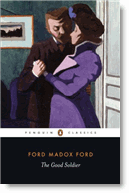 So I read several good books - some of them very good - throughout July. The best one, however, was one that I didn't like at all, initially: Ford Madox Ford's The Good Soldier. It's a simple story, of a man who discovers that his wife and his friend were having a long affair - written in a way that goes backwards and forwards over the story. And for the first twenty pages I found it very slow-going - I didn't like that it wasn't clear what had happened; I didn't like John Dowell's impressionistic version of events. Then something happened - I'm not sure what - but something clicked. Everything that I had disliked up until that point made sense, and The Good Soldier became one of the most realistic books I've read. Every time Dowell revisited an event, each time with a slightly different perspective on the subject - I understood it the better, for isn't that how all events are filtered through our memories, changing with each mood and with each new bit of information? Although Dowell admits that he's biased and that it's hard to give a complete version of the truth - isn't that the point of the book?
Beyond that, I can't offer much more - other than to say that Dowell's wife, Florence, must be one of the most unlikeable characters in English literature. But it was a book I loved, was sad to finish, and cannot imagine improving. I can't think of anything constructive to say about it - nothing that isn't immediately obvious, anyway. Not that I wouldn't enjoy reading an essay on The Good Soldier - but it's a book upon which impressed me so thoroughly that my only response can be applause.
Sunday, 7 August 2011
Technical update

(Source.)
Wednesday, 20 July 2011
Review: The Collector by John Fowles (and others)
Two thirds of the way into July so I'd better post this before it gets any further into the month.

I have already recorded that I didn't read any books for leisure throughout May, so it seems that throughout June I made up for last time. I finished Amanda Foreman's A World on Fire, her history of the complex, paradoxical, and often retaliatory relationship between Britain and America during the American Civil War; it was thoroughly, thoroughly excellent. I would review it but I lack the ability to do it justice; indeed, it is such a long book that a comprehensive review would take longer to write than I have time on my hands. Foreman has done a wonderful job; the inclusion of cartoons from Punch spread throughout the book alongside the text was an inspired decision.
I also read Alexander Masters' Stuart: A Life Backwards, which was what they call a moving read. This sensational biography of Stuart Shorter, a homeless man, is novel for starting with the end of his life and moving backwards into his past to show what influenced him to become the man he was by the time of his death. The idea is to look at Shorter's life as a kind of murder mystery: what killed the innocent boy he once was? The device works, and the final third of the book is extremely bleak indeed.
There were some duds. Through work I received a copy of David Almond's new book, The Monster Billy Dean, which disappointed me. It's a post-apocalyptical story about a boy brought up in near-isolation, taught about Christianity but not about the outside world; Billy Dean is special for being able to communicate with the dead. Words are spelt almost phonetically throughout the book which contributes to the sense of Billy Dean's isolation. Unfortunately, I didn't think that the story quite lived up to what was promised by its cover and the publisher's letter. I think I was expecting something darkly atmospheric, something bloodcurdling enough to be a little trashy, yet with enough pretensions that it might be literary. I wanted to be reminded of the eerier moments in Susanna Clark's Jonathan Strange and Mr Norrell, I wanted a sub-Shirley Jackson story - perhaps something about feral children. The book didn't do any of these things for me, and I think that my dissatisfaction irreparably clouded my enjoyment.
Winter's Bone by Daniel Woodrell - the story of an Ozarks girl on the hunt for her meth-cooking father to turn into the police - was rather murky. It was well-written - and far more atmospheric than Billy Dean - but ultimately forgettable. It did have some engaging details that I wish the film had retained - Ree's loss of virginity, her relationship with her best friend, the horror of her uncle's face destroyed by an accident while cooking meth - but it's not one that I'd rush out to buy again.

I read Diana Wynne Jones' final book, Earwig and the Witch, which was as entertaining as anything else she wrote. I adore Jones' writing - Fire and Hemlock is a regular "top tenner" when listing my favourite books - and this last of hers managed to strike the right note of being "darkly adorable" (the illustrations help). It was the story of an orphan girl called Earwig who's adopted and enslaved by a woman called Bella Yaga, who only wants her around to help with her spells; Earwig, a girl used to getting her own way at the orphanage, now decides to scheme her way into becoming a witch herself. Only the ending felt a little rushed - I got the feeling that perhaps it was finished by well-intentioned family and editors after Jones' death - but I still loved it.
In fact, I was all set to make Earwig and the Witch the main focus of this post, even though it was written for young children - but then I read John Fowles' The Collector. I thought it was an absolutely wonderful book - sort of as if Nabokov had written Emma Donoghue's Room. Set in the 1960s, a young man is obsessed with an art student, whom he abducts and keeps locked up in the cellar of his isolated cottage, storing her like one of the butterfly specimens he also collects. I imagine it was an extremely difficult book to write - Frederick Clegg actually seems almost reasonable during his narration. It is only in the second half of the book, told through a series of diary entries written by the kidnapped Miranda, that Clegg's "weirdness" is put into perspective.

In spite of any sympathy owed to her awful situation, Miranda herself is not wholly likeable - she's snobbish ("The ordinary man is the curse of civilization" (127)) hypocritical, self-obsessed - but I was impressed by how much her imperfections made me appreciate her, and to her credit, she frequently recognises the flaws in her character, reflecting on what she's written and done and criticising poor behaviour. We talk about "real" characters in books - she seemed real to me. I certainly appreciated her interest in and ability to discuss literature - she was able to compare herself and her situation to other literary moments. Halfway through the novel she thinks, "I am Emma Woodhouse" (157) - I am Miranda - or at least, I was when I was her age, twenty.
Curiously, there wasn't - or I didn't catch - a reference to Pamela, an obvious example of captivity in the western canon, and considering the frequent allusions to Emma, Sense and Sensibility, The Catcher in the Rye, Romeo and Juliet, Robinson Crusoe, various paintings, and (most notably) The Tempest, this omission appears to be an oversight. Perhaps Miranda simply wasn't familiar with the work. Clegg certainly wouldn't have been.
Religion is a modest-running theme throughout The Collector; not the prevailing subject (that's class) but it appeared often enough to interest me. There are frequent references to Clegg's semi-religious upbringing; he was "brought up in the atmosphere" (13) of Christianity in spite of his nonconformist aunt and still retains the loosely puritanical beliefs of childhood. Certain things are "not nice", such as sexual promiscuity in women.
Miranda does not appear to have had a particularly religious upbringing - at most, we can imagine that it was vaguely Church of England, in the way that most girls of her class in the 1960s were vaguely Church of England. She believes in God - and even prays to him occasionally - although a Christian God is not a defining aspect of her life until the end. Early on in the story she asserts herself as a Buddhist, although she does not repeat this belief. It appears to be part of her self-identification with the Left.
Yet religious lifestyles are far more important to Clegg and Miranda than either of them seem to realise. Each of them unconsciously follows a religious path. Clegg, surprisingly, aligns himself with western Buddhism, which as I understand it, promotes the acceptance of situations for what they are. Clegg is unwilling to alter his own lifestyle unless necessary and cannot understand why Miranda can't come to loves him. In fact, most of Clegg's motivation throughout the book comes from the belief that if Miranda contemplates her situation properly, she will realise that she loves him. He is unwavering in this principle and his position at the end of the book is much the same as it was at the beginning. Miranda's failure to love him is her fault, with her "la-di-da ideas and clever tricks" (282).
By contrast, Miranda, for all her modern views, is demonstrative of one of the ideals behind western Christianity: that a person is imperfect and must strive for self-improvement. Her development is only partly spiritual, going from subservience to God to hatred - "he's a great loathsome spider in the darkness…God is impotent…I hate beyond hate" (255). Similarly, her experience with violence until her capture has been observant - the "H-bomb" and teddy-boys harassing Indians - and the idea of violence makes her "feel weak". Yet eventually a physical attack is something she must do.
Her experience has aspects of a religious retreat - albeit one of luxury. Being kept in isolation in a cellar for months, she has time to think and reflect. She must discard her former principles and compromise her beliefs in order to have a chance at survival and escape. Unlike Clegg, she does go through several transformations. Enlightenment is perhaps too strong a word for her path but her development throughout the book, her ability to think and question herself, are certainly increased. Would it be too hideous to retain the butterfly metaphor here?
Sunday, 3 July 2011
The Beggar's Opera at Regent's Park
Last night I went to see The Beggar's Opera at Regent's Park Open Air Theatre - a wonderful performance. They used an eighteenth-century setting - unusual for older drama, these days - and managed a perfect evocation of old London. I was overwhelmed with emotion, almost to tears, during the opening: a Newgate prison scene, wordless, semi-comic, with traditional music playing in the background - it was so well staged. As a theatrical achievement it was aesthetically marvellous - as the Open Air Theatre always is - and was the perfect tonic for reinvigorating my interest in the subject.
Although there hasn't been a place for The Beggar's Opera in my work so far, the performance has made me look at it in a new way - made me think, "Ooh, maybe...!" I'm looking forward to getting down to work this coming week in consequence - it's so thrilling to be excited and interested in work.
Although there hasn't been a place for The Beggar's Opera in my work so far, the performance has made me look at it in a new way - made me think, "Ooh, maybe...!" I'm looking forward to getting down to work this coming week in consequence - it's so thrilling to be excited and interested in work.
Tuesday, 21 June 2011
Farces
I've read quite a few farces over the past few days - a fantastic dramatic genre for my research as they frequently emphasise the extravagance and bombasticity of heroic drama.
Picking plays to use is a dicey subject, though: I spent ages on Sunday looking for William D'Avenant's The Playhouse to be Let (1663), the fifth act of which, I had read, is one of the earliest examples of English burlesque. It features several characters typical of heroic dramas, tragedies, and romances - Cleopatra, Marc Anthony, and Caesar - presented in a decidedly unromantic way. Once I had finally found a copy online, through EEBO, it was a little disappointing. It was very short (not even five pages long) and about the best joke was the consistent naming of Anthony as "Tony" - as farcical jokes go, rather weak.
Reading Thomas Duffett's The Empress of Morocco (1674) now, which is slightly more interesting - especially as the cast-list reveals that the female characters were all played by men in its original run. It's a direct spoof of Elkanah Settle's own The Empress of Morocco and turns the London underclasses into a sort of alternative Moroccan nobility: Morena, the titular empress, is also an "apple woman", for example.
Speaking objectively, I do feel that a lot of farces of this period have fallen out of popularity deservedly. There's a lot of pantomime humour in them, which makes them extremely useful to use as sources to tell us what was popular in the late seventeenth century - the humour in The Playhouse to be Let, for example, derrives from the baseness of Cleopatra et al's behaviour, and indicates that the official take on them was far more serious. By burlesquing their characters in suggesting an everyday humanity to their behaviour, pretension of taste and ideology is being lampooned. As I say, this is interesting for what it tells us about seventeenth-century cultural. beliefs. Yet at the same time, no one can expect a modern audience to go to a play fully briefed on all the intricacies of Restoration culture and society. And as much as anything else, a lot of the humour is very cheap, frequently with a rushed feel about it.
All the same, I'll defend The Dragon of Wantley to the death. Cheap or not, any hero who wins the day by kicking his adversary in the bum is pretty funny.
Picking plays to use is a dicey subject, though: I spent ages on Sunday looking for William D'Avenant's The Playhouse to be Let (1663), the fifth act of which, I had read, is one of the earliest examples of English burlesque. It features several characters typical of heroic dramas, tragedies, and romances - Cleopatra, Marc Anthony, and Caesar - presented in a decidedly unromantic way. Once I had finally found a copy online, through EEBO, it was a little disappointing. It was very short (not even five pages long) and about the best joke was the consistent naming of Anthony as "Tony" - as farcical jokes go, rather weak.
Reading Thomas Duffett's The Empress of Morocco (1674) now, which is slightly more interesting - especially as the cast-list reveals that the female characters were all played by men in its original run. It's a direct spoof of Elkanah Settle's own The Empress of Morocco and turns the London underclasses into a sort of alternative Moroccan nobility: Morena, the titular empress, is also an "apple woman", for example.
Speaking objectively, I do feel that a lot of farces of this period have fallen out of popularity deservedly. There's a lot of pantomime humour in them, which makes them extremely useful to use as sources to tell us what was popular in the late seventeenth century - the humour in The Playhouse to be Let, for example, derrives from the baseness of Cleopatra et al's behaviour, and indicates that the official take on them was far more serious. By burlesquing their characters in suggesting an everyday humanity to their behaviour, pretension of taste and ideology is being lampooned. As I say, this is interesting for what it tells us about seventeenth-century cultural. beliefs. Yet at the same time, no one can expect a modern audience to go to a play fully briefed on all the intricacies of Restoration culture and society. And as much as anything else, a lot of the humour is very cheap, frequently with a rushed feel about it.
All the same, I'll defend The Dragon of Wantley to the death. Cheap or not, any hero who wins the day by kicking his adversary in the bum is pretty funny.
Saturday, 18 June 2011
The Assignation - Dryden
I read Thomas Sourtherne's adaptation of Oroonoko earlier this week and it was rather a strange play. I'm not sure whether I like it or not; I think I need to write a blog so that I can puzzle it out for myself.
That will come later, though. At the moment I'm reading Dryden's The Assignation, a standard little drama which I'm not sure I'll use. However, I did just come across an interesting scene. Ascanio, a man about town, and Hippolita, a novice, are talking about their friends' budding romance - and doing a bit of flirting themselves. They then have the following charming exchange:
That will come later, though. At the moment I'm reading Dryden's The Assignation, a standard little drama which I'm not sure I'll use. However, I did just come across an interesting scene. Ascanio, a man about town, and Hippolita, a novice, are talking about their friends' budding romance - and doing a bit of flirting themselves. They then have the following charming exchange:
HIPPOLITA: Dare you make all this good you have said of your Master?
ASCANIO: Yes, and as much more of my self to you.
HIPPOLITA: I defy you upon't, as my Lady's Second.
ASCANIO: As my Masters, I accept it. The time?
HIPPOLITA: Six this evening.
ASCANIO: The place?
HIPPOLITA: At this Grate.
ASCANIO: The Weapons?
HIPPOLITA: Hands, and it may be Lips.
ASCANIO: 'Tis enough: expect to hear from me. II:I Duelling language! To arrange a romantic tryst! More than anything, this gives a good example of the sort of duelling language that a mid seventeenth-century audience would be familiar with. I was very excited.
Subscribe to:
Posts (Atom)